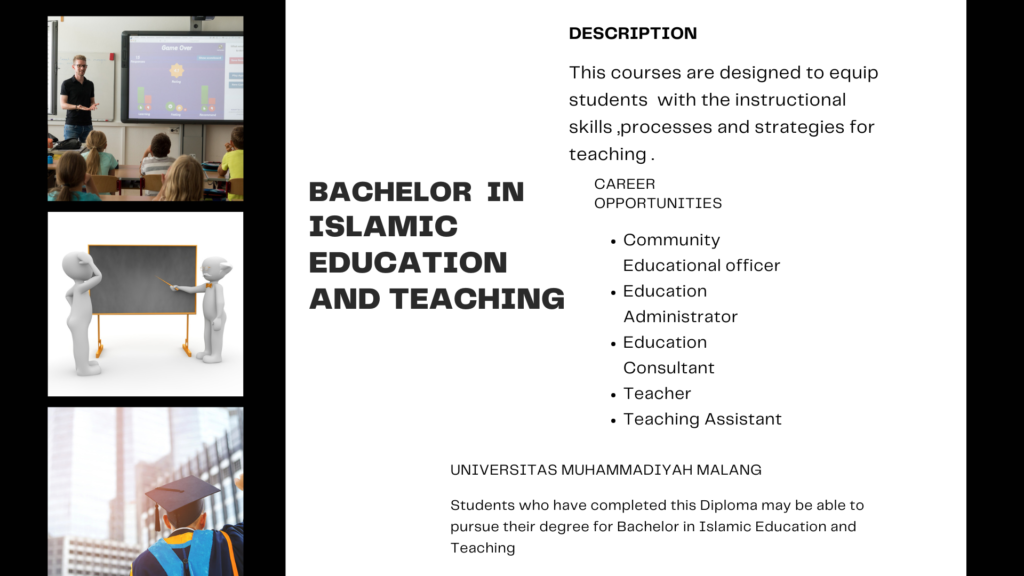
Bachelor in Islamic Education and Teaching
Prepare to teach with knowledge and integrity. Build expertise in Islamic pedagogy, curriculum design, and classroom leadership — equipping you to nurture faith and learning in the next generation.
Nurturing Faith, Knowledge, and Character in the Next Generation
Develop the pedagogical expertise, academic grounding, and leadership skills required to excel as a transformative educator in Islamic schools, madrasahs, and educational institutions.
Programme Overview
The Bachelor in Islamic Education & Teaching is a comprehensive undergraduate degree that bridges classical Islamic sciences with modern educational psychology, instructional design, and classroom management.
This programme goes beyond traditional teaching methods by focusing on Tarbiyah (holistic development), Ta’lim (knowledge transmission), and Ta’dib (character building). Student teachers will learn to design engaging, value-based curricula, utilize educational technology ethically, and foster inclusive, faith-centered learning environments.
What You Will Learn
- Islamic Educational Foundations: The philosophy, history, and spiritual goals of education in Islam.
- Classical Islamic Knowledge: Essential grounding in Quranic studies, Hadith, Seerah, Fiqh, and Islamic creed (Aqidah).
- Pedagogy & Instructional Strategies: Active learning methodologies, differentiated instruction, and inquiry-based teaching.
- Curriculum Design & Assessment: Developing lesson plans, mapping learning outcomes, and constructing fair assessment tools.
- Child & Adolescent Psychology: Understanding cognitive, emotional, and spiritual development stages in young learners.
- EdTech & Digital Learning: Integrating digital tools, online platforms, and AI into faith-based instruction.
- Classroom Management & Character Building: Cultivating a positive classroom culture rooted in Adab (etiquette) and Rahmah (compassion).
Year-by-Year Course Outline
Year 1: Foundations of Faith & Pedagogy
- BIET 101: Philosophy of Islamic Education (Tarbiyah, Ta’lim, Ta’dib)
- BIET 102: Introduction to Educational Psychology & Learning Theories
- BIET 103: Sciences of the Quran (Ulum al-Quran) for Educators
- BIET 104: Seerah as a Pedagogical Model
- BIET 105: Fundamentals of Arabic Language for Teaching
- BIET 106: Classroom Dynamics & Student Behavior Management
Year 2: Curriculum, Methods & Instructional Design
- BIET 201: Instructional Methods for Islamic Studies
- BIET 202: Curriculum Planning, Mapping, and Assessment
- BIET 203: Hadith Literature & Pedagogical Applications
- BIET 204: Child & Adolescent Mental Health and Pastoral Care
- BIET 205: Teaching Arabic & Tajweed: Techniques and Practice
- BIET 206: Educational Technology & Digital Media in the Classroom
Year 3: Advanced Pedagogy & Specialized Teaching
- BIET 301: Ethics, Law (Fiqh), and Governance for Educators
- BIET 302: Inclusive Education & Special Educational Needs (SEN)
- BIET 303: Teaching Comparative Religion & Worldviews
- BIET 304: Action Research in Educational Settings
- BIET 305: Character Development (Tazkiyah) & Mentorship Strategies
- BIET 306: Microteaching & Peer Mentorship Lab
Year 4: Professional Internship & Capstone Project
- BIET 401: School Leadership & Educational Administration
- BIET 402: Contemporary Issues in Islamic Education
- BIET 403: Educational Research Project (Dissertation/Capstone)
- BIET 404: Teaching Practicum I (School Placement & Observation)
- BIET 405: Teaching Practicum II (Full-Classroom Guided Teaching)
Career Pathways
Graduates of this programme are equipped for diverse roles across the education sector, including:
- Islamic Studies & Arabic Teachers in primary and secondary schools
- Madrasah & Quranic Educators
- Curriculum Developers & Educational Consultants
- School Administrators & Academic Coordinators
- Youth Mentors & Community Education Officers
Programme Structure & Details
- Duration: 4 Years (Full-Time) / 5–6 Years (Part-Time)
- Format: Lectures, interactive seminars, microteaching labs, and in-school practicum placements
- Assessment: Coursework assignments, teaching portfolios, action research project, and school-based evaluations
- Degree Awarded: Bachelor in Islamic Education & Teaching
Inspire the Leaders of Tomorrow
Step into a rewarding career that combines professional teaching excellence with lifelong spiritual impact.